Cookies help us to offer you a personalised browsing experience and to measure our audience. You can configure them at any time and consult our privacy policy.
This website uses cookies to improve your experience when browsing the website. Of these, cookies classified as necessary are stored on your browser because they are essential for the basic functionality of the website to work. We also use third-party cookies to help us analyse and understand how you use this website. These cookies will only be stored on your browser with your consent. You also have the option of refusing these cookies. However, deactivating some of these cookies may have an effect on your browsing experience.
Marketing
Essentials
Analysis & Performance
Functional
This is a demo store. No orders will be fulfilled.
Would this plant suit my garden?
Set up your Plantfit profile →
Filter
Sort by:
Display
4results
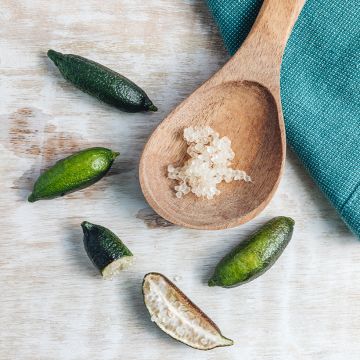
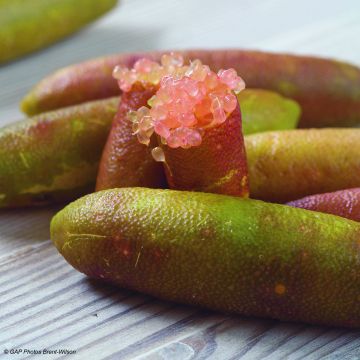
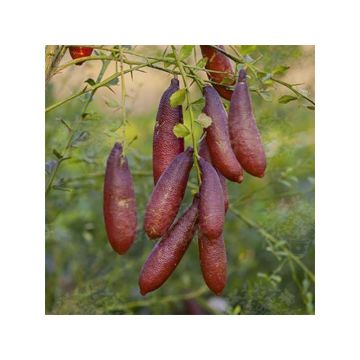
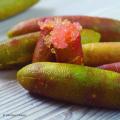
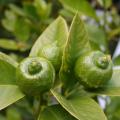
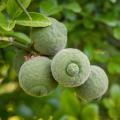
The famous Caviar Lime is highly sought after by Chefs around the world! It is an Australian citrus tree, which is small in all its parts, hence its genus name Microcitrus. The slender and fragile branches, bear tiny leaves, minuscule spines, and green fruits, no bigger than a finger.
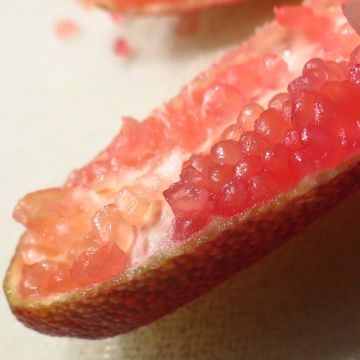
The pulp of these small fruits, composed of small juicy and crunchy beads is delicious, which is the origin of its popularity and its nickname "caviar lime". The fruits are harvested from October to December.
In general, citrus trees thrive in open ground in Mediterranean coastal regions where they find the necessary warmth all year round. But to fruit well, they must not lack water or nutrients. The caviar lime is not very hardy and it starts to suffer from the cold as soon as it reaches -3°C. It is a self-fertile bush, which means that a single individual is enough for complete pollination and fruiting.
It is recommended to grow Microcitrus australasica in a pot which allows the plant to be protected in winter.
The famous Caviar Lime is highly sought after by Chefs around the world! It is an Australian citrus tree, which is small in all its parts, hence its genus name Microcitrus. The slender and fragile branches, bear tiny leaves, minuscule spines, and green fruits, no bigger than a finger.
The pulp of these small fruits, composed of small juicy and crunchy beads is delicious, which is the origin of its popularity and its nickname "caviar lime". The fruits are harvested from October to December.
In general, citrus trees thrive in open ground in Mediterranean coastal regions where they find the necessary warmth all year round. But to fruit well, they must not lack water or nutrients. The caviar lime is not very hardy and it starts to suffer from the cold as soon as it reaches -3°C. It is a self-fertile bush, which means that a single individual is enough for complete pollination and fruiting.
It is recommended to grow Microcitrus australasica in a pot which allows the plant to be protected in winter.
The flowering period indicated on our website applies to countries and regions located in USDA zone 8 (France, the United Kingdom, Ireland, the Netherlands, etc.)
It will vary according to where you live:
In zones 9 to 10 (Italy, Spain, Greece, etc.), flowering will occur about 2 to 4 weeks earlier.
In zones 6 to 7 (Germany, Poland, Slovenia, and lower mountainous regions), flowering will be delayed by 2 to 3 weeks.
In zone 5 (Central Europe, Scandinavia), blooming will be delayed by 3 to 5 weeks.
In temperate climates, pruning of spring-flowering shrubs (forsythia, spireas, etc.) should be done just after flowering.
Pruning of summer-flowering shrubs (Indian Lilac, Perovskia, etc.) can be done in winter or spring.
In cold regions as well as with frost-sensitive plants, avoid pruning too early when severe frosts may still occur.
The planting period indicated on our website applies to countries and regions located in USDA zone 8 (France, United Kingdom, Ireland, Netherlands).
It will vary according to where you live:
In Mediterranean zones (Marseille, Madrid, Milan, etc.), autumn and winter are the best planting periods.
In continental zones (Strasbourg, Munich, Vienna, etc.), delay planting by 2 to 3 weeks in spring and bring it forward by 2 to 4 weeks in autumn.
In mountainous regions (the Alps, Pyrenees, Carpathians, etc.), it is best to plant in late spring (May-June) or late summer (August-September).
The harvesting period indicated on our website applies to countries and regions in USDA zone 8 (France, England, Ireland, the Netherlands).
In colder areas (Scandinavia, Poland, Austria...) fruit and vegetable harvests are likely to be delayed by 3-4 weeks.
In warmer areas (Italy, Spain, Greece, etc.), harvesting will probably take place earlier, depending on weather conditions.
The sowing periods indicated on our website apply to countries and regions within USDA Zone 8 (France, UK, Ireland, Netherlands).
In colder areas (Scandinavia, Poland, Austria...), delay any outdoor sowing by 3-4 weeks, or sow under glass.
In warmer climes (Italy, Spain, Greece, etc.), bring outdoor sowing forward by a few weeks.